
Caroline Pitcher
Senior Marketing Manager, Kerv Experience
Have a question?
Get in touchPublished 17/02/26 under:
As district and county councils merge to form unitary organisations, customer experience (CX) is being thrust further into the spotlight. Residents expect clear information, consistent service and quick resolution. What they actually get hinges on successfully consolidating multiple systems, standards and work practices. How well CX is managed throughout these structural changes also shapes public trust and determines whether projected efficiencies are realised.
Somerset Council understands this only too well. Read on to discover how its contact centre has become a strategic lever, improving efficiency and customer satisfaction across 1.2 million annual interactions involving over 155 council functions and 1,100 services.
Peer Learning and Knowledge Sharing
Now in its fifth year, the Kerv local government forum provides CX and service leaders with an effective platform for sharing ideas, making budgets stretch and achieving more. That focus aligns closely with the long-term vision outlined in ‘A blueprint for modern digital government’, a six point plan for improvement, particularly around the first two points: Join up public sector services and Harness the power of AI for the public good.
Hear the details of the background, challenges and opportunities of Somerset Council's move to a unitary organisation.Watch the CX Roundtable featuring Somerset
Overcoming the Significant Challenge of Unitary Change
Somerset is largely a rural county with a population of just over 570,000, many of whom are aged 65 and over. These demographics naturally shape service demand, particularly in areas such as adult social care, transport accessibility, housing and healthcare.
Residents were previously served by five district councils: Somerset County Council, Mendip, Sedgemoor, Somerset West and Taunton and South Somerset. Each had its own contact centre with different voice platforms (Genesys, 8×8 and Enghouse), phone numbers, opening times, out-of-hours cover, case management systems, IVR options and routing strategies.
This fragmented approach caused confusion among customers navigating their way through 1,100 separate services as well as internal management challenges, such as duplicated effort, non-standardised KPIs and poor reporting and visibility into performance.
All of which negatively impacted resident experience. The time taken to reach the right team and resolve issues added to frustrations, not helped by inconsistent agent knowledge, skill sets and work practices.
A business case detailing the opportunity for merging into one unitary council was presented and approved in 2021. The vesting day was set for April 2023, with the aim of creating a single front door to public services, reducing complexity for residents. This immovable timescale was driven by the annual council tax billing process, which all local authorities go through.
Solution Design and Partner Selection
Aligned with the local government reorganisation (LGR) framework, the Somerset project team spoke with peers from other councils. Overwhelming feedback was that the longer channel consolidation was left, the harder it became to achieve. After scoping this omnichannel approach with internal stakeholders, a new solution design emerged with seven must-have capabilities:
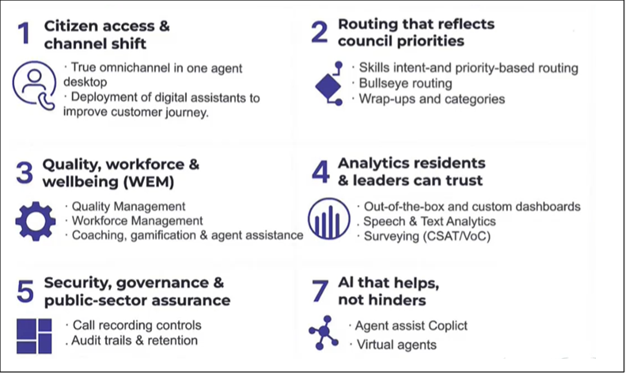
Another key deliverable was finding a partner experienced in government contact centre transformation – one who could not only support existing voice, email, web messenger and Facebook channels, but also transfer knowledge and invest time helping to upskill in–house teams.
One Phone Number and Consistent Experience
After a diligent procurement exercise, a Kerv proposal was deemed to have performed best across all areas. The new solution has enabled Somerset Council to unify disparate systems and processes, providing residents with single access and a consistent contact centre experience, regardless of which legacy council they previously engaged with.
Each council’s IVR system was migrated in its current state, allowing advisors to get comfortable with Genesys Cloud in the lead-up to Vesting Day. Voice bots were subsequently added to capture intent data.
As a precaution, the project team developed an online area checker tool and recruited 12 temps to handle additional enquiries. As it transpired, they weren’t needed. The bot performed better than expected routing residents 47% faster (compared to IVR) to the right agent in 90% of cases.
Other results included a 10% drop in no intent rates, a 50% decrease in abandoned calls and a 10% rise in customer satisfaction (CSAT), from 77% to 87%. Call transfers also reduced, aided by an improved central knowledge base and advisors able to learn from each other.
Speeding CX Innovation
A digital assistant was also introduced, initially for ICT Helpdesk callers, reducing handling time for tasks like password resets and link requests for forms and webpages. Building on this success, the AI-powered solution was expanded across other resident-facing services such as Blue Badge, Facebook, Parking, Waste and School Admissions.
Digital assistants currently resolve around 60% of enquiries on first contact. The other 40% of calls seamlessly transfer to advisors, together with comprehensive notes so customers don’t have to repeat themselves.
Partnering with Kerv and upskilling our teams has been really valuable. As a result, we can now build out our routing and digital assistants, develop new scripts and troubleshoot issues – without relying heavily on external support.
Further developments since vesting day include driving channel shift with automated SMS links for waste services. Now, when residents call from a mobile, the bot sends a text with a link, an initiative that has helped increase form submission rates by 20%. Kerv helped develop a bespoke CSAT tool for after-call surveys, thereby retiring the previous third-party solution.
Data captured within Genesys Cloud automatically feeds into Microsoft Power BI reporting dashboards, eliminating previous time-consuming, manual processes. Moreover, Somerset Council has created a solid foundation for future transformation to meet the changing needs of its residents and the challenges of further service consolidation.
Lessons Learnt and Recommendations
However, it’s not been all plain sailing. Over the last few years, like most authorities, Somerset Council has had to adapt to financial emergencies, structural reorganisations and other perennial public sector challenges, resulting in a subsequent call on budgets and resources.
In many ways, this magnifies its achievements while serving as a useful reference for other local authorities wrestling with the challenges of unitary transition. Critical enablers behind the Council’s successful digital transformation and single front door strategy include:
- Clear objectives, strong leadership and strategic partnerships.
- Balancing automation with a human touch, especially for elderly and vulnerable residents.
- Phased deployment to reduce risk and build internal capabilities, ensuring sustainable adoption.
- Improved metrics and plans for enhanced self-service and analytics, demonstrating commitment to ongoing innovation.
Read the Somerset County Council case study here.
As the longest standing Genesys Cloud partner in EMEA, Kerv has successfully deployed Genesys Cloud to over 25,000 agents in 100+ customers. Drawing on our unrivalled technical support, 24/7 managed services and customer success practice, we obsessively ensure Kerv customers always get the greatest benefit from their Genesys investment.