
James Berger
Solutions Architect | Kerv Digital Transformation
Have a question?
Get in touchPublished 02/09/26
The most interesting thing I’ve learned from putting AI into a live customer service environment is that the AI isn’t really the hard part. For a big part of my time since joining Kerv, I’ve been working as the Solution Architect on a major transformation programme for one of the UK’s largest charities.
The programme has brought together Genesys Cloud, Microsoft Dynamics 365, Power Platform and Azure to support a national helpline.
More recently, we’ve taken another significant step: embedding generative AI through Microsoft Foundry into that live service.
It’s something I haven’t really spoken about publicly before and probably one of the most interesting things I’ve worked on.
The problem wasn’t really an AI problem
A substantive interaction could last around 45 minutes, followed by up to another 20 minutes documenting what happened.
At the scale of a national service, those minutes add up quickly.
The opportunity for AI sounds obvious: transcribe the conversation, summarise it and reduce some of that administration.
But putting that into a real service particularly one handling incredibly sensitive interactions is very different from demonstrating it.
You have to think much more deeply about where AI fits, what context it needs and, importantly, where it should stop
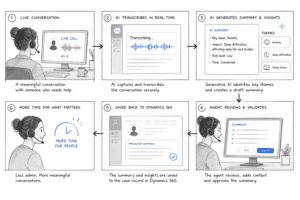
An illustration of how AI can support the customer service journey from live conversation and transcription to AI-generated insight, human review and structured information in Dynamics 365.
The scale changes the conversation
This is where a relatively simple use case becomes much more interesting.
Publicly available figures show that one major UK children’s helpline delivered more than 160,000 counselling sessions in a single year. Not every one of those sessions follows the process we’ve built for, but it gives you an idea of the scale these services can operate at.
Even as a simple illustration, save 10 minutes on an activity happening 160,000 times and you’re talking about more than:
26,000 hours of potential capacity.
That’s what interests me.
The value isn’t really in AI being able to summarise a conversation.
It’s what becomes possible when you remove small amounts of work from something that happens at enormous scale.
And building this has reinforced three things for me.
1. AI is only as useful as the context around it
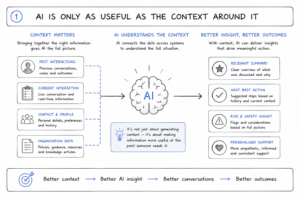
AI shouldn’t mean another tool or another screen. The real opportunity is embedding intelligence into the flow of work, exactly where and when it’s needed.
Summarising a conversation is relatively straightforward.
Understanding that conversation in the context of what happened before, what is happening now and what might need to happen next is much more valuable.
That’s where bringing together Genesys Cloud, Dynamics 365, Power Platform, Azure and Microsoft Foundry becomes important.
The opportunity isn’t simply to generate content.
It’s to make the information already moving through an organisation more useful at the point somebody needs it.
2. The best AI might be the AI you don’t have to go looking for
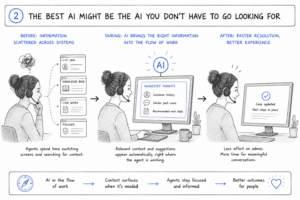
AI shouldn’t mean another tool or another screen. The real opportunity is embedding intelligence into the flow of work, exactly where and when it’s needed.
We didn’t want to build another place for somebody to “use AI”.
We’ve embedded intelligence into the existing workflow and surfaced it back within the tools people are already using.
I think that’s an important shift.
We’ve spent the last few years talking about copilots, generative AI and, increasingly, AI agents and agentic experiences.
Those developments are incredibly exciting.
But for many organisations, I think there’s a huge opportunity sitting right in front of us:
AI in the flow of work.
Understanding the interaction. Bringing together context. Reducing administration. Helping somebody get to the information they need faster.
Without asking them to leave the process they’re already in.
3. More AI doesn’t mean less human
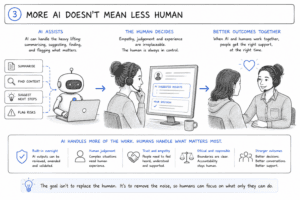
AI can take on more of the work around an interaction, while people retain the judgement, empathy and accountability that matter most.
This is probably the most important lesson from the programme.
When the conversations involved can be incredibly sensitive, you have to think carefully about the boundary between AI and human judgement.
Our principle has remained simple:
AI assists. The human decides.
AI-generated information can be reviewed, amended and validated by the person using it.
Human oversight isn’t sitting outside the solution.
It’s designed into it.
And I think that’s going to become even more important as AI becomes increasingly capable and we move towards more agentic and autonomous experiences.
The question shouldn’t only be:
“What can we automate?”
It should also be:
“What should remain human?”
That’s where I think customer service gets interesting
Working on this programme has changed the way I think about AI.
We naturally focus on the big ideas: agents, assistants, automation and autonomy.
But there’s potentially enormous value in something much less glamorous.
The work around the conversation.
Reading.
Summarising.
Categorising.
Searching for context.
Documenting.
Moving information between systems.
Individually, those things don’t sound transformational.
Do them hundreds of thousands of times and they become a very different proposition.
And when the conversation itself really matters, giving the person handling it more time and better context becomes much more meaningful than simply making a process faster.
So the question I’m increasingly interested in isn’t “what else can we automate?”
It’s this:
Where does AI create genuine value when the human interaction is the thing that matters most?
For me, this programme has given one possible answer.
Use AI to understand MORE of the context, remove MORE of the work around the interaction and put better information in front of the person who needs it.
Then let the human do what humans do best.
After spending a big part of my time at Kerv helping take this from architecture into a live service, I’m incredibly proud of what the wider team has delivered.
It’s also shown me the value of bringing Kerv’s Genesys and Microsoft capabilities together connecting the contact centre, CRM, Power Platform, Azure and AI rather than treating them as separate technology conversations.
And I think we’re only at the start of what’s possible.
AI shouldn’t make the human interaction less important. The opportunity is to use it to make more room for it.